By Philip Matogo
The late Soviet Union leader Joseph Stalin’s major show trials, known as the Moscow Trials, took place between 1936 and 1938 during the height of the Great Purge.
A prominent Bolshevik called Nikolai Bukharin, described by revolutionary and former Soviet leader Vladimir Lenin as a “most valuable and major theorist” of the Communist Party, was active in the Soviet government from the 1917 revolution until his purge in 1938.
Before his execution in March 1938, Nikolai Bukharin wrote a famous, deeply personal final letter to Soviet leader Joseph Stalin from his prison cell containing the haunting question:
“Koba, why do you need me to die?”
Bukharin used Stalin’s old revolutionary underground nickname, “Koba,” to appeal to their past friendship and close political partnership. Found in Stalin’s private desk drawer after Stalin’s death in 1953, the letter represents a final, desperate attempt to plead for his life and preserve his historical legacy.
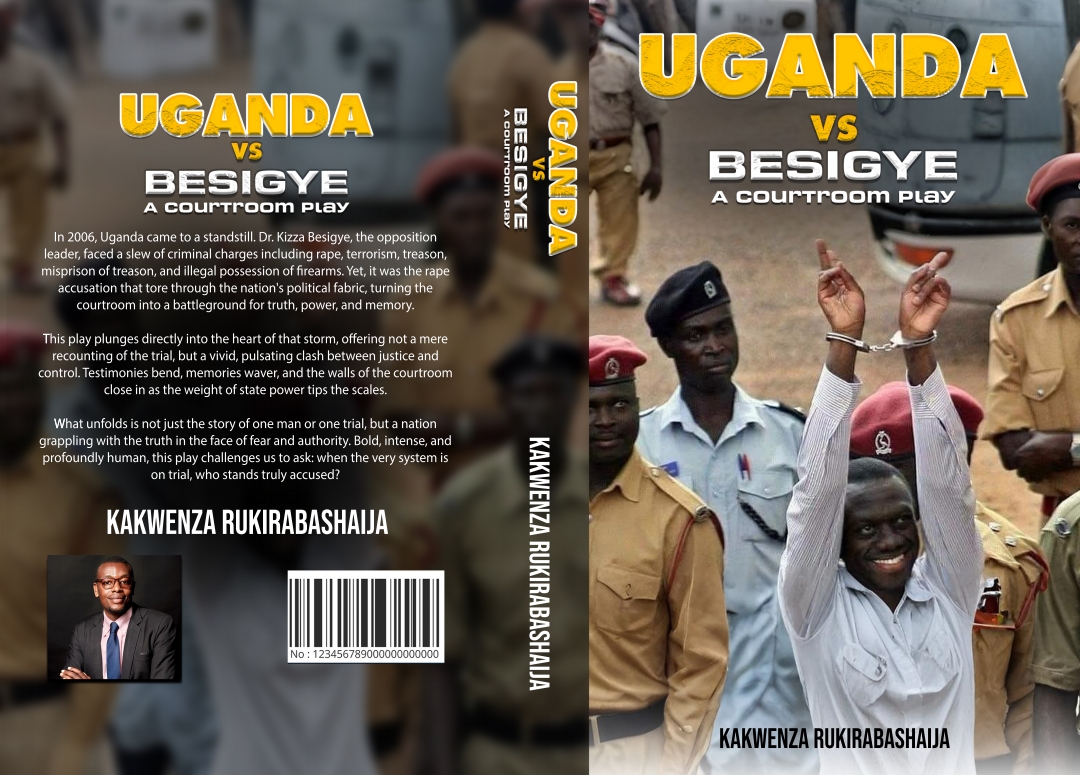
Kakwenza Rukirabashaija, a Ugandan novelist and lawyer, has a new book titled Uganda vs Besigye: A Courtroom Play. It implicitly recalls Stalin’s purge in a limited fashion.
Kizza Besigye, a former comrade of President Yoweri Museveni, was charged with rape in late 2005 after returning from exile, and the High Court of Uganda acquitted him of the charge on March 7, 2006, ruling that the prosecution’s case was fabricated and plagued by contradictions.
Kakwenza implies in his new book that Besigye was subjected to a show trial in league with Bukharin’s lingering death. However the distinction is that Besigye and Museveni fell out and Bukharin and Stalin were still presumed political allies until politics surreptitiously overcame their solidarity.
Not because Bukharin threatened Stalin’s rule in the manner Besigye threatened President Museveni’s, but because Stalin assumed he would. Hence, the subsequent event was what a former Ugandan police officer would probably term a preventive execution.
The similarity between both trials, Besigye’s and Bukharin’s, if Kakwenza’s book is to be believed, is the theatricality.
Kakwenza, writing rather objectively, reminds us how university student Joanita Kyakuwa accused Besigye of raping her.
“To support Joanita’s story, the prosecution brought in Aisha Nakiguli, a maid who had also been mistreated. She had kept quiet at first because she feared her employer [Besigye]. The police detained her overnight before taking her statement, and later she received a house and a poultry business from the state. The court saw this as a forced and paid testimony, which made it worthless in law, even though it supported the complainant,” writes Kakwenza.
Gone is the polemicist and satirist as Kakwenza attempts a lawyerly look at a case he ultimately designates as one big drama.
“The trial operated as a theatrical performance, which this subsequent play transcribed through formal language,” writes Kakwenza in the prefatory essay.
“The dramatic nature of this case arises from both the statements made during the trial and the unspoken elements that remained hidden.”
Adding:
“The courtroom functions as a stage where witnesses perform under pressure and lawyers craft stories through their arguments. The judge [Justice John Bosco Katutsi] uses wit to fulfill his dual role as decision-maker and narrator who exposes the false nature of events.”
Thus the judge as narrator in this play is a character and an outside voice that speaks directly to the audience. He tells the background story, explaining what is happening, and guiding the plot forward.
This book does not serve as a platform for Kizza Besigye’s declamations of President Museveni’s regime. Scene One: The Accused’s Silence puts paid to that.
The play’s character Besigye is more reflective than acerbic when he notes:
“They say silence is weakness, that it’s emptiness, but I’ve learned otherwise—that silence is armour and power. Words are fragile; they bend, they twist, they are turned against the one who speaks them. But silence resists, and it cannot be rewritten and misconstrued, it stands.”
These words speak more to Besigye’s current predicament than what he experienced during this 2005 trial. This might be, by a kind of inversion, his very indictment of the system that has incarcerated him.
In the history of drama, silence is never just an empty space. From classical tragedy to modern absurdism, playwrights use calculated quietness to shift power, reveal hidden subtext, and force audiences to feel intense psychological tension.
Scripted silences—such as Cordelia’s refusal to flatter Lear or the Ghost in Hamlet walking away unspeaking—create moments of profound suffering and moral doubt.
The author by being less remonstrative than he is known to be thus brings forth a literary offering that says all that must be said, by not saying it all.