
By Philip Matogo
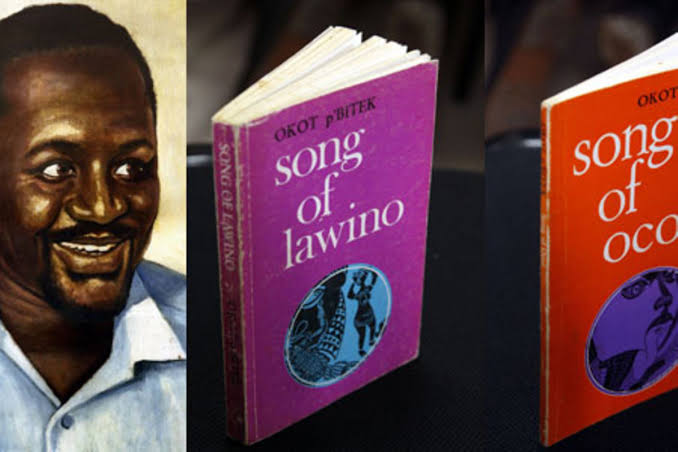
60 Years of Song of LawinoThis year marks the 60th anniversary of the publication of Song of Lawino, the game-changing epic poem by peerless Ugandan poet, anthropologist, and scholar Okot p’Bitek, first released in 1966.Okot p’Bitek’s matchless and evocative poetic styling directly founded the Song School of poetry (also known as the East African School of Song).This creation or curation, if you will, not only cast adrift alien poetic forms in the shape of Western poetic structures; it set in motion a sea change in African and world literature. In the place of suddenly shipwrecked Western poetic forms, as it were, a flotilla of traditional oral art forms, dramatic monologues with peculiar African virtuosity and eddied social commentary, the Song School of poetry set sail on poetry’s otherwise choppy waters.Its horizons were vast, expanded by the singular personality of Okot p’Bitek himself.Unquiet OriginsOkot p’Bitek’s story began rather auspiciously in Gulu in 1931 when he made his debut on this side of eternity into a prominent Protestant family. He attended the Church Missionary Society (CMS) secondary school, Gulu High School, before completing his secondary studies at the elite Ganda preparatory school, King’s College, Budo.After two additional years of training in Mbarara, he returned to Gulu to conduct the Anglican choir at Sir Samuel Baker’s School. During the late 1950s and early 1960s, p’Bitek completed courses at the Universities of Bristol, Wales (Aberystwyth), and Oxford.After returning to Uganda from the United Kingdom, p’Bitek joined Makerere College in Kampala.He soon after began working with the Ugandan Cultural Centre, where he established his reputation as the foremost poet and cultural writer in East Africa.He began writing Wer pa Lawino or Song of Lawino during the height of in the late 1950s and completed it in 1966. It was initially written in Acholi, then translated into English.Heartbreaking StoryThis long or epic poem tells the story of Lawino, whose life is subject to the crushing realities of domesticity under the unblinkingly critical eye of a stern Catholic husband, Ocol.As the poem begins, Ocol is struck and attracted to Lawino’s blinding good looks. She recalled the beginnings of their courtship:«“When Ocol was wooing meMy breasts were erect,And they shookAs I walkedI threw my long neckThis way and that wayLike the flower of the lyomo lilyWaving in a gentle breeze.”»Then, love’s famished road turned. Lawino is given a reality check that she can only cash on the bounce of reversed fortunes. She realizes that she has regrettably attracted the affection of a fire and brimstone Catholic, who deigns to consider Acholi culture with disdain:«“He [Ocol] says my mother is a witch,That my clansmen are foolsBecause they eat rats,He says we are all Kaffirs [heathens],We do not know the ways of God,We sit in deep darknessAnd do not know the Gospel,He says my mother hides her charmsIn her necklaceAnd that we are all sorcerers.”»Although Ocol is nominally Catholic, he is essentially a holier-than-thou Catholic that takes against indigenous cultures and spiritual systems.The poem thereupon reveals Lawino as a harried spouse. She is ridiculed incessantly because she does not know how to properly cross herself according to Catholic custom.As she comes in for relentless verbal assaults from Ocol, Lawino cannot get her head around why the Acholi gloss, Rubanga, is used to describe the Catholic God. The term was the name of the spirit that caused tuberculosis of the spine, which led Lawino to describe the Virgin Mary as the Mother of a Hunchback.Lawino is further left confused by what she perceives as the untoward behavior of the Verona Fathers, who in the poem drink with abandon and gaze wide-eyed and openmouthed at women’s breasts.When questioned on such moral impropriety, a priest, she laments, “threatens you with his beard”!The sanctimonious teachers of religion, Lawino concludes plaintively, “hate questions”.Yet questions are all she is left with as she laments throughout the poem. A paradise lost is what her love once was for Ocol.The structure of the poem sits on a two-legged stool.One, according to several Ugandan scholars, the rhythms of the Song School of poetry are deeply rooted in the oral traditions, musical beats, and speech patterns of East African communities, particularly the Acholi people.Instead of using Western metrical feet (like iambic pentameter), Okot p’Bitek and his contemporaries structured their verses to mimic the cadences of spoken word performance, and song.This, one might add, is not essentially African. It is human and found in the origins of poetry in the West, which also sprang from oral tradition.According to several Western scholars, works like Homer’s Iliad and Odyssey began as spoken oral performances. Bards or lyrical poets used rhythmic meters and repeating stock phrases to remember and recite long stories.Again, in medieval times, Germanic and Romance traditions, such as Beowulf and The Song of Roland, grew out of oral storytelling cultures before being written down by scribes.If we also delve into meters and rhymes, elements of poetry like rhythm, meter, and alliteration originated because they made spoken words easier to memorize and share by mouth.So the Song School of Poetry could be seen as a synthesis instead of a thesis of unique African poetry that is antithetical to Western structural poeticisms.The second leg of the aforementioned poetic stool that the Song of Lawino rests on is its less than overt critique of Roman Catholicism in Chapters 10 and 11. The Last Safari to Payok [place of death or no return], is an unsparing of Catholicism’s perceived feet of clay.The irascible Ocol ridicules Acholi hygiene, hospitality, medicinal herbs, relics and parenting practices. Out of this blizzard of frosty rejections, Lawino is left weather-beaten but wiser:«“My husband rejects meBecause he saysThat I am a mere paganAnd I believe in the devil.”»The bipolarity of belief and faith that have driven a wedge between Ocol and Lawino is what this poem is hinged upon to represent the duality of good and evil between African traditions and Western mores.Duality shapes how we experience life through opposing forces like joy and sorrow, light and dark.Song of Lawino thus runs the full gamut of human experience, that’s what makes it an epic poem in the strictest sense of that designation.