By Philip Matogo
In 1991, my brother Derek and I arrived at King’s College, Budo. We were both enrolled in Senior Two. My father hoped we would be shaped in the school’s forge. After all, it is a preparatory school whose scholastic bent is to make Kings (and Queens) out of its students.
Derek and I both previously cut our educational teeth in the International School of Tanganyika (IST). This Dar es Salaam based school is a school for the money elite and has an American country club feel to it. It’s a different ball of academic wax.
Budo, although a Ganda top drawer establishment, had mistaken delusions of grandeur that cast it as the Eton of Africa. To Derek and I, however, it represented a culture shock.
At Budo, we were introduced to obligatory cold showers, pit latrines and posho and beans leavened by bellyup bean weevils for the first time in our lives.
Derek was placed in England House and I found myself in Australia House. Both dormitories, the latter was home to pit latrines imaginatively known as Sydney. We both wondered how we ended up Down Under, astride in the dark underbelly of academia.
Or so we thought it was.
We soon found ourselves amidst the best and brightest academic minds we had ever encountered.
In my first term, I finished 58th out of a class of 58. Derek fared only marginally better.
At IST, being smart translated to being uncool as the eggheads were deemed nerds in typical American high school idiom. At Budo, however, brains were considered cool. Everyone aspired to be sharp.
One of the young blades at Budo was Kirk Katende, scion to the celebrated lawyer, John Katende. Kirk was a guy who spoke with the grandiloquence of a Shakespearean soliloquy.
His penchant for outsize words was lauded and legendary. His flights of rhetoric often filtered down to our collective admiration. Thereby enriching, inadvertently, a poetic tradition at the school.
Some students poked fun at this magniloquent culture.
There was a Senior Five student called Collin Mutambo, an Australian, who was mercilessly mocked in the school paper. In full back bush glory, a hairstyle that put a premium on more hair at the back than front, he was portrayed in a school cartoon commenting, “That was quite an acrimony”. This after a stage performance that was quite peaceful and pleasant.
Then there was the school prefect Opio who liked to use the word “dogma”. When his sister joined in Senior Five, she was promptly labelled “Bitchma” while his younger brother Steven was designated as Puppyma.
This verbal mischief points to the sardonic wit of Simon Kaheru, but I have no evidence or proof that it was him who coined those expressions.
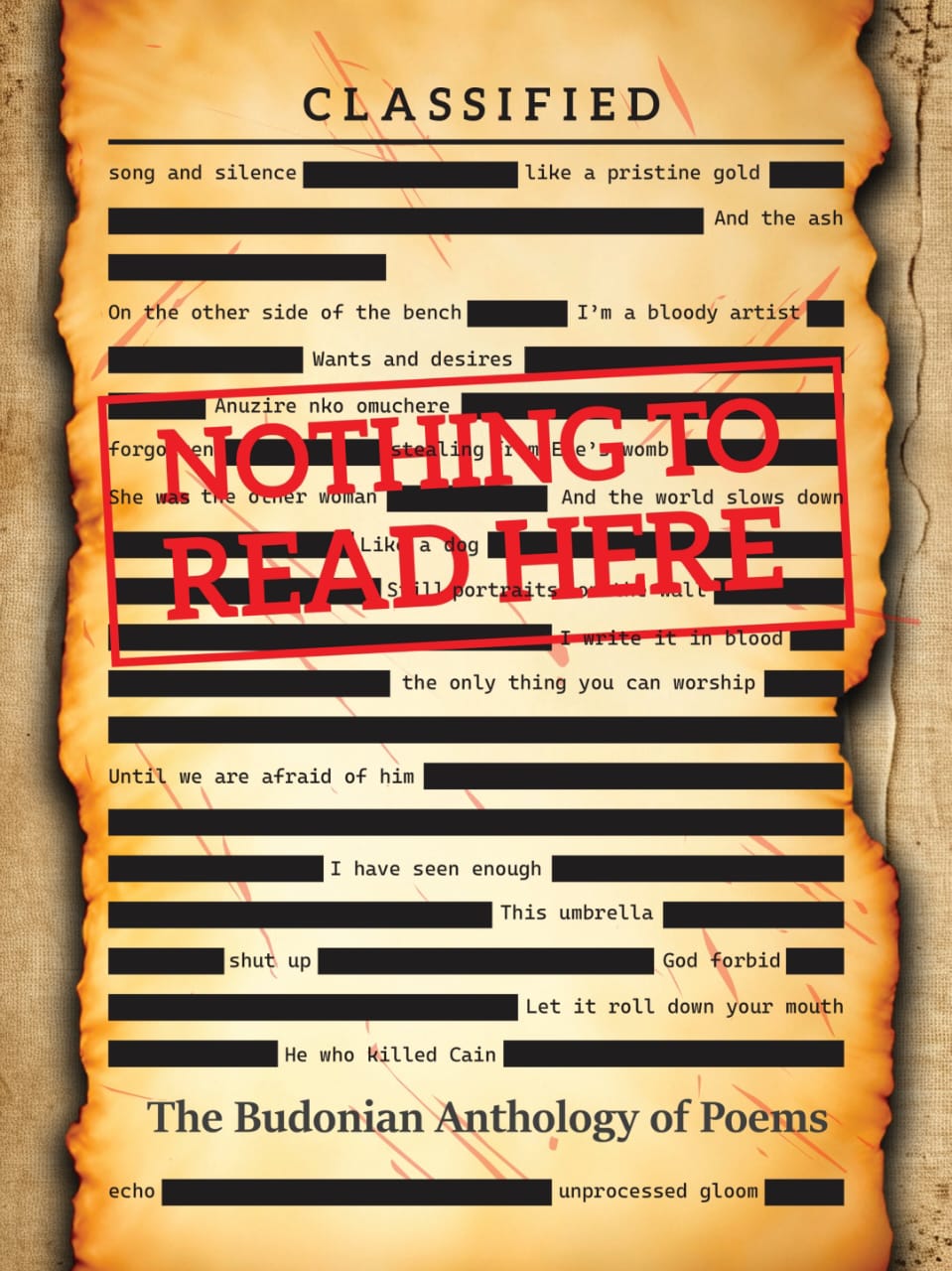
In the 2026 King’s College, Budo poetry anthology titled Nothing To Read Here, latter day Budonian student wits and poets keep up this artistry with words.
This new book, whose launch I presided over as Guest of Honour, is subdivided into six parts, each called boxes.
“This anthology is but a mere snippet. A small glimpse into what goes on in the lives and minds of those that very painstakingly (or not, my bet is on the former though), carry the weight of the red lion upon their chest, and an attempt to encapsulate their essence,” writes the President of Budo’s Readers’ and Writers’ Club (2024/25), Nowamaani Trust Assimwe.
Adding:
“Is it 100% accurate? Probably not. Our writers have a tendency of being a tad overly dramatic (okay, more than just a tad but that’s my personal opinion, I’ll leave that up to your discretion). I won’t say much, as there are enough voices in this book to speak for centuries, so I will just leave this simple question. Look around. Tell me what you see. If you see nothing, then I suggest you revise your perception. Usually, we drape nothing over all that actually is to have deniability and claim ignorance. For once, don’t do that. So once more I ask, look around and tell me, what do you see? Where there is nothing, in actuality is everything.”
This poetic offering is a product of the mighty Kitara Nation led by the inimitable bard Peter Ngobi Kagayi.
Kitara Nation is a past master of free verse.
What is Free Verse?
According to the Brittania:
Free verse is a form of poetry that does not adhere to a fixed meter, rhyme scheme, or specific structure, allowing the poet greater freedom in expression. Despite lacking traditional constraints, free verse often relies on other poetic elements, such as rhythm, imagery, and line breaks, to create meaning and evoke emotions.
Characteristics of Free Verse
1. No Fixed Meter: Free verse does not follow a consistent rhythmic pattern like iambic pentameter.
2. No Rhyme Scheme: It lacks a regular rhyme scheme but may use internal rhyme or assonance.
3. Focus on Natural Speech Patterns: The rhythm often mimics everyday speech.
4. Creative Lineation: Line breaks are used to emphasize specific words, ideas, or images.
5. Imagery and Symbolism: Rich imagery and symbolism are frequently employed to convey meaning.
Examples of Free Verse
Here are examples from notable poets who used free verse:
1. Walt Whitman — Father of Free Verse
From Song of Myself:
“I celebrate myself, and sing myself,
And what I assume you shall assume,
For every atom belonging to me as good belongs to you.”
2. Ezra Pound
From The Garden:
“Like a skein of loose silk blown against a wall
She walks by the railing of a path in Kensington Gardens,
And she is dying piece-meal
of a sort of emotional anemia.”
3. T. S. Eliot
From The Love Song of J. Alfred Prufrock:
“Let us go then, you and I,
When the evening is spread out against the sky
Like a patient etherized upon a table.”
4. Carl Sandburg
From Fog:
“The fog comes
on little cat feet.
It sits looking
over harbor and city
on silent haunches
and then moves on.”
5. Langston Hughes
From Dreams:
“Hold fast to dreams
For if dreams die
Life is a broken-winged bird
That cannot fly.”
Significance of Free Verse
Flexibility: Poets can experiment with form and structure, focusing on content and emotion rather than adhering to rules.
Modern Appeal: It became a hallmark of modernist poetry, reflecting a break from tradition and the influence of individual creativity.
Universal Expression: Without formal constraints, free verse allows for a wide range of subjects and styles, making it accessible and versatile.
Free verse remains a powerful poetic form that prioritizes the poet’s voice and vision over traditional conventions.