By Philip Matogo
Across the streets of Kampala, Uganda’s creative potential is everywhere. You can find young and older people drawing human portraits for money, singing in public spaces, practising yoga, making crafts, designing clothes, producing art pieces, telling stories on stages, dancing, performing and creating forms of expression that are often overlooked as part of the economy.
These activities demonstrate something important: Uganda does not lack creative talent. It lacks a deliberate system for identifying, organizing, developing and scaling that talent.
When we speak about Uganda’s creative economy, however, the conversation often narrows to the most visible industries, particularly music, dance and filmmaking. These are important, but they represent only part of the country’s creative capacity.
Where do the portrait artists, sculptors, craft makers, fashion designers, storytellers, spoken-word artists, visual artists, performers, photographers, yoga practitioners and many other emerging forms of creativity fit?
This is the gap we need to address.
From Survival to Impact
Stories are already being told across Uganda—in newspapers, online publications, TikTok, YouTube and other visual and digital platforms. Artists are creating every day.
Yet many creatives remain trapped in a cycle of creating primarily to survive. They respond to immediate demand, current trends or whatever can generate income today, rather than deliberately developing work that builds identity, communicates a message, creates cultural value or influences society.
The creative economy should not be built around survival alone. It should be organized around impact.
A creative person should be able to ask not only, “How can I make money from this?” but also, “What can I create that people will remember, value, buy, experience, share and carry into the future?”
This requires deliberate education.
Uganda needs mass public education about the breadth of the creative economy so that society begins to recognize creative work as more than entertainment.
A person creating a sculpture, designing clothing, illustrating a story, performing poetry, creating crafts or developing an artistic experience is participating in an economy that can generate employment, cultural identity, tourism, exports and social influence.
Creatives themselves also need education—not only in their craft, but in business, partnerships, marketing, pricing, intellectual property, presentation, branding, digital distribution and international market access.
They must learn how to turn talent into sustainable economic activity.
The Power of Creative Collaboration
Organization is equally important.
Many creative activities require materials, equipment, spaces, promotion and specialized skills that individual creatives may struggle to afford. Organized groups can pool resources, share equipment, combine different skills and produce work that is more distinctive and valuable.
Imagine a project bringing together a storyteller, fashion designer, sculptor, photographer, musician, dancer and visual artist.
Instead of each person surviving independently, their different capabilities could produce one powerful cultural product, exhibition, performance, campaign or commercial experience.
Collaboration can turn individual creativity into collective economic value.
This also requires a different understanding of partnerships. Creatives should not only look for customers. They should learn to partner with businesses, hotels, tourism operators, schools, governments, NGOs, media organizations, technology companies and international cultural institutions.
Uganda’s unique stories, artistic traditions, people and landscapes can become assets that strengthen other sectors of the economy.
Art can support tourism.
Storytelling can support education.
Design can support manufacturing.
Fashion can support agriculture through locally sourced materials.
Film and visual arts can preserve culture.
Creative campaigns can support public health and social development.
Cultural products can become exports.
The creative economy can therefore contribute far beyond the entertainment industry.
Building an Environment Where Creativity Can Grow
Government also has a role to play.
If Uganda recognizes creativity as an economic sector, it should receive deliberate support in the same way other productive industries are developed.
This does not mean simply giving artists money. It means creating an environment in which creative businesses can develop skills, access equipment and workspace, form enterprises, reach markets, protect intellectual property, access finance and participate in local and international opportunities.
The greatest danger is that if this transformation is not deliberate, Uganda’s creative economy will continue to be defined by the few industries that have already achieved visibility, while thousands of other talented people remain on the margins, creating occasionally for survival and depending on a small market for luxury purchases.
Uganda has something distinctive to offer the world: its stories, imagination, culture, craftsmanship and way of seeing life.
But talent alone does not create an industry.
Talent must be organized. Skills must be developed. Creatives must collaborate. Markets must be created. Institutions must recognize the sector. And creativity must be given the opportunity to move from survival to impact.
The question is therefore not whether Uganda has a creative economy.
It does.
The question is whether we are prepared to organize it well enough for its full value to be seen—by Ugandans first, and eventually by the world.
The Vision Behind Zaza
This thinking forms part of the broader vision behind Zaza Organization, an Economic Ecosystem Intelligence Organization focused on organizing Africa’s economic ecosystems.
Africa’s greatest untapped asset is not simply its natural resources, but the millions of people already creating economic value every day through farming, trading, transport, artisanship, small businesses and creative work.
Much of this activity remains informal, fragmented, poorly documented and disconnected from finance, institutions and larger markets. As a result, it is difficult to measure, support, scale or recognize as productive economic capacity.
Zaza seeks to change this.
Rather than treating the informal economy simply as a problem that must be formalized, Zaza approaches it as an existing economic asset that needs to be understood, strengthened, organized and connected.
The Zaza Method™ provides a pathway:
Financialize → Analyze → Systemize → Digitalize → Mobilize → Marketize
The process begins with understanding an individual or business, its economic activity and the constraints preventing profitable growth.
The next step is solving those constraints through appropriate operating systems, making economic activity digitally visible, measuring performance and connecting stronger individuals into digital communities.
Eventually, these communities can be linked to finance, suppliers, contracts and wider markets.
The long-term objective is to transform fragmented and invisible economic activity into organized, measurable and increasingly bankable economic capacity—creating stronger foundations for inclusive growth and prosperity.
From a Personal Experience to Zaza
For Felex Niwagaba, the thinking behind Zaza began with a personal experience that changed how he understood poverty, finance and development.
When he was thirteen, his school fees were stolen from his dormitory and he was sent home.
With no money for transport, he walked more than 35 kilometres, wondering how he would face his mother. She was a peasant farmer and small trader whose work had fed the family and paid for their education.
When they returned to the school to plead for another opportunity, the institution could see a missing school fee, but it could not see the economic effort behind it.
His mother eventually sold land that supported their livelihood and relied on community borrowing, produce sales and trade to keep him in school.
Years later, Niwagaba began experimenting with collective economic organization.
At 18, he created Katuna Youths Cooperative, where 20 young people saved weekly to invest together. At 27, he started Friends of Benefit, where members saved monthly towards a common goal.
These experiences taught him that groups alone do not necessarily create prosperity when the economic foundations of their members remain weak.
His professional work subsequently exposed him to another side of the problem. Working on financial operating systems for SACCOs, savings groups and lenders showed him that even institutions serving informal workers often lacked the systems and data needed to understand them properly.
The problem, he realized, was larger than finance.
People were creating value, but the systems around them could not see, measure or strengthen it.
That became the foundation of Zaza.
Looking Towards 2050
Zaza’s ambition extends beyond Uganda’s creative sector.
The organization envisions becoming part of an African economic infrastructure that helps make the continent’s existing productive capacity visible, organized and scalable.
Its immediate focus is on strengthening individual economic actors—helping farmers, traders, artisans, riders, creatives and SMEs understand their activities, improve profitability, solve operational constraints and build reliable economic records.
Simple activities such as sales, expenses, production, inventory and other transactions can become structured information. This allows individuals and businesses to understand their performance and progressively build an economic and financial identity.
Once individuals and businesses become stronger, they can be connected into digital communities and virtual cooperatives based on shared economic interests.
Those communities could subsequently access knowledge, finance, suppliers, institutional support and collective opportunities.
The final stage is market access: connecting organized economic capacity to corporate and government procurement, development organizations, suppliers, investors, financial institutions and regional and global markets.
By 2050, the vision is of an Africa where informal work is no longer treated as invisible survival activity, but recognized as productive capacity that can be understood, improved, financed and scaled.
The ultimate objective is prosperity built from the economic activity Africans are already creating.
Africa’s greatest opportunity is not waiting to be discovered. It is waiting to be organized.
About Felex Niwagaba
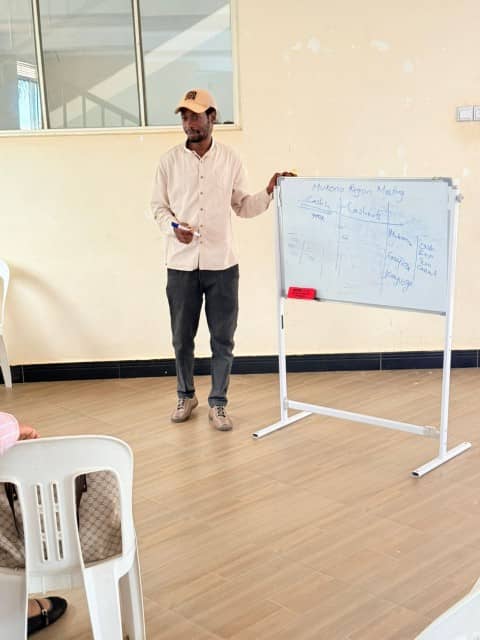
Felex Niwagaba is a Ugandan systems architect, entrepreneur and development thinker focused on building practical systems that help people and institutions create, organize and scale value. His work spans financial services, technology, healthcare, business operations and community development.
His interest in systems transformation grew from personal experiences with the challenges faced by ordinary economic actors whose work creates value but often remains invisible to the institutions capable of supporting their growth.
Professionally, he has worked on financial and lending operating systems, including SACCO and microfinance infrastructure, and has contributed to healthcare technology and operational systems. He has also experimented with collective economic organization through initiatives including Katuna Youths Cooperative and Friends of Benefit.
He is the director of Zaza Organization, an emerging initiative built around a broader vision of organizing Africa’s economic ecosystems and transforming invisible economic activity into measurable, productive and increasingly bankable value.