
You need to login in order to like this post: click here
By Deograsius Latimson
There are dates that belong to calendars, and there are dates that become part of history.
September 11, 2001, became the latter.
It began as an ordinary Tuesday morning. People went to work. Parents said goodbye to their children. Passengers boarded flights. Thousands entered the World Trade Center expecting to return home later that day.
Many never did.
Within hours, the September 11 attacks had claimed 2,977 victims from more than 90 countries. They had also changed the course of modern history.
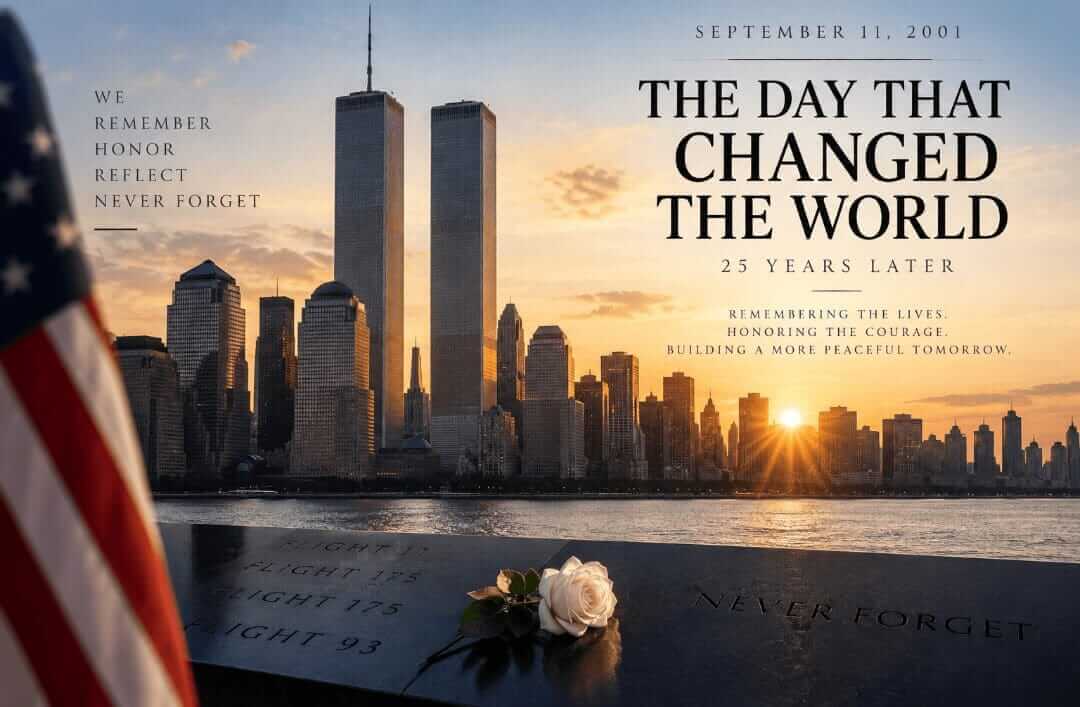
Today, September 11, 2026, marks 25 years since that tragic morning. As the world remembers, we look beyond the destruction to the people who lost their lives, the courage of those who responded and the lessons that remain a quarter of a century later.
The Morning of September 11
On September 11, 2001, 19 terrorists associated with al-Qaeda hijacked four commercial passenger planes in the United States.
At 8:46 a.m., American Airlines Flight 11 crashed into the North Tower of the World Trade Center in New York City.
At first, many people did not understand what had happened. Confusion spread as television networks began broadcasting images from Manhattan.
Then, at 9:03 a.m., United Airlines Flight 175 struck the South Tower.
At that moment, it became clear that the United States was under attack.
Soon afterward, at 9:37 a.m., American Airlines Flight 77 crashed into the Pentagon in Arlington, Virginia.
However, there was still another hijacked aircraft in the sky.
United Airlines Flight 93 was heading toward Washington, D.C. After passengers and crew members learned about the other attacks through phone calls, they decided to fight back.
At 10:03 a.m., Flight 93 crashed into a field near Shanksville, Pennsylvania. The aircraft never reached the hijackers’ intended target.
The Twin Towers Fall
Meanwhile, the situation in New York was becoming increasingly desperate.
Fires burned across the upper floors of the World Trade Center. Thousands of people tried to escape while firefighters, police officers and other emergency workers rushed toward the buildings.
At 9:59 a.m., the South Tower collapsed.
Just 29 minutes later, at 10:28 a.m., the North Tower also fell.
Within a short period, two buildings that had helped define the New York City skyline were gone.
Huge clouds of dust and debris covered the surrounding streets. Across the world, millions watched the disaster unfold on television.
The images of that morning would become some of the most recognizable images in modern history.
The Human Cost of the September 11 Attacks
Behind the destruction was an even greater tragedy: the loss of human life.
The September 11 attacks killed 2,977 victims from more than 90 countries.
They included office workers, airline passengers, crew members, firefighters, police officers and other emergency personnel. They were also parents, children, husbands, wives, relatives, friends and colleagues.
Thousands of others were injured.
Yet numbers alone cannot fully describe the tragedy.
Behind every number was a person. Behind every person was a family, a community and a story that continued in their absence.
Therefore, remembering September 11 should not only be about the buildings that fell. Above all, it should be about the people whose lives were lost.
Courage in the Face of Terror
Even in the middle of tragedy, extraordinary acts of courage emerged.
As thousands of people tried to leave the World Trade Center, firefighters, police officers and other emergency responders moved in the opposite direction.
They went toward the danger.
Some climbed floor after floor carrying heavy equipment as they searched for people who needed help. Many of those first responders never returned home.
Courage was also visible aboard Flight 93.
After learning about the attacks in New York and at the Pentagon, passengers and crew members fought back against the hijackers. Their resistance prevented the aircraft from reaching its intended target.
Meanwhile, ordinary people also stepped forward to help.
People assisted strangers, treated the injured, donated blood and offered shelter. Others joined rescue and recovery efforts.
The September 11 attacks showed the terrible consequences of terrorism. At the same time, the response showed extraordinary courage, compassion and solidarity.
How September 11 Changed the World
The effects of September 11 reached far beyond New York, Virginia and Pennsylvania.
In the years that followed, governments changed the way they approached terrorism, intelligence and national security.
Air travel also changed significantly. Airports introduced stronger security measures, while governments increased intelligence sharing and counterterrorism operations.
In addition, the attacks transformed American foreign policy.
The United States launched what became known as the War on Terror. Military operations in Afghanistan began only weeks after the attacks.
Over time, the political and military consequences spread far beyond the United States. They affected international relations, security policies and conflicts for decades.
As a result, September 11 became a dividing line for an entire generation.
There was the world before 9/11 and the world after it.
September 11, Twenty-Five Years Later
Today, September 11, 2026, marks exactly 25 years since the attacks.
A quarter of a century has passed. However, the significance of that morning remains.
An entire generation has now grown up without personal memories of September 11, 2001. Many people alive today were not yet born when the Twin Towers fell.
For them, the events survive through photographs, videos, documentaries, museums, classrooms and stories passed from one generation to another.
That makes remembrance even more important.
History survives when its stories continue to be told.
Remembering More Than a Tragedy
Remembering September 11 does not mean remembering terrorism alone.
It means remembering people who left home that morning expecting to return.
It means remembering the first responders who entered burning buildings while thousands of others were trying to escape.
It means remembering the passengers and crew members aboard Flight 93 who chose to resist.
It means remembering families who lost parents, children, siblings, spouses, relatives and friends.
Most importantly, it means remembering the devastating cost that hatred, violence and extremism can impose on humanity.
September 11, 2001, began as an ordinary day.
By the time it ended, nearly 3,000 people had been killed. Families across more than 90 nations were grieving, and the course of world history had changed.
Twenty-five years later, the responsibility to remember remains.
To remember the lives lost.
To honor courage and sacrifice.
To learn from history.
And to never forget.
You need to login in order to like this post: click here