You need to login in order to like this post: click here
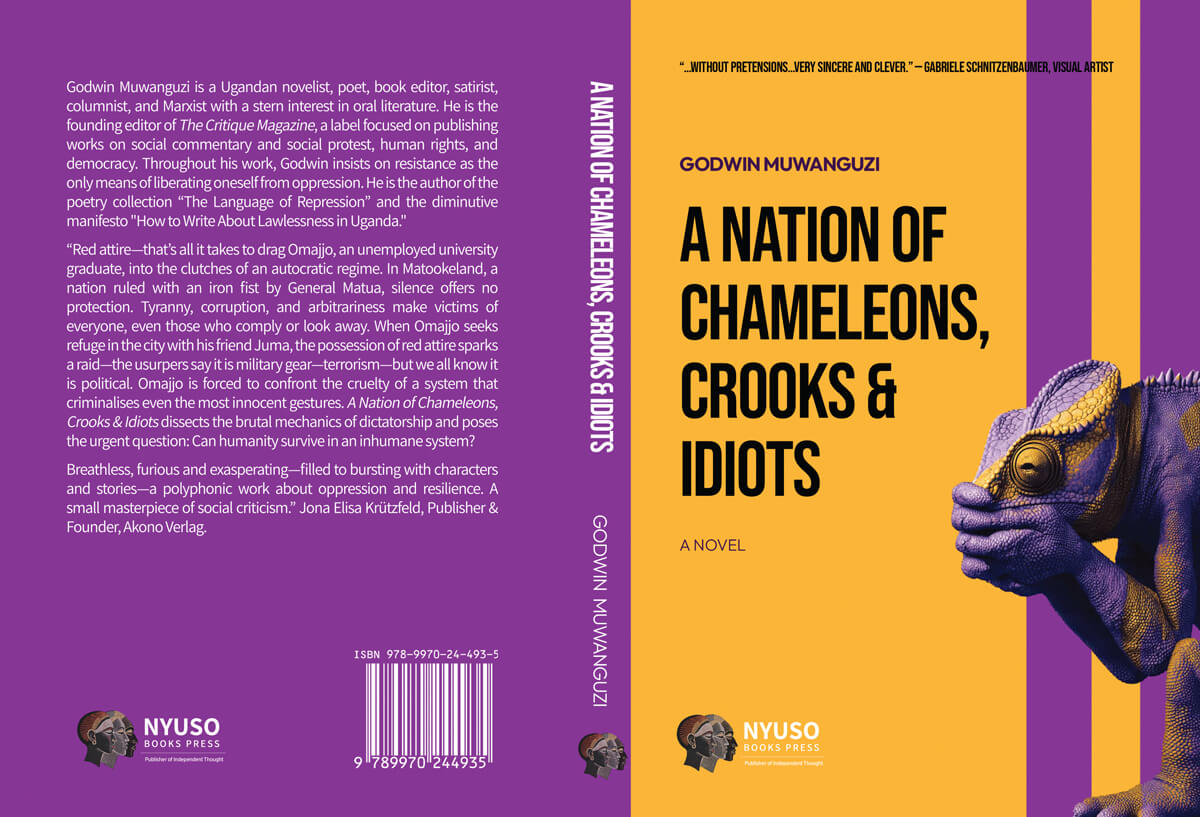
Title: Chameleons, Crooks & Idiots
Author: Godwin Muwanguzi
We find ourselves in a place called Matookeland. It’s a fictional country, but the land and the matooke are not. That’s how you know you’re dealing with a roman à clef, a literary genre where authors disguise real people, places, or events using fictional names and settings.
The term translates from French as “novel with a key,” indicating that the key to understanding the real identities behind the characters is often provided within the text itself.
Maybe you’ll recognize some of the country’s defining characteristics as chameleonic because in this country survival depends on how one changes tack and disposition depending on certain circumstances. This brings out a duality of reality whence politicians extol virtue while typifying vice. Good governance and value-addition civics are shunted aside; injustice takes their places like a cloaked dagger.
The good citizens of Matookeland learn that if they speak against such a pass, they might pass on in mysterious circumstances, get locked up or simply vanish without a trace. Life on the razor’s edge cuts deep into their quiet desperation.
Well, that’s until the chief protagonist Omajjo springs into the collective consciousness of a people left tongue-tied by a conspiracy of silence. His mother, a single parent, has seen the country go through paroxysms of corruption, land grabbing, murder and all its regrettable trimmings. She counsels caution but remains principled, with a prime eye on a better future for her country, her son and herself. Not exactly in that order.
Omajjo is a rebel. He refuses to fiddle as Rome burns, as it were. Taking on the laurel of saying the unsaid, he becomes a tribune of the people by speaking truth to power against tide of the times.
A Nation of Chameleons, Crooks & Idiots presents a very real tragedy of a people mired in their own terror, fear and hypocrisy. To survive they are silent against the impersonal march of the times. Otherized by their need to survive in a predatory society, Matookeland experiences a national out of body experience.
Tyranny is shorthand for governance and the people’s values are circling the drain. Power, especially when it seeps to every level, corrupts absolutely. It all begins with what could be described as a fashion faux pas.
“Red attire—that’s all it takes to drag Omajjo, an unemployed university graduate, into the clutches of an autocratic regime. In Matookeland, a nation ruled with an iron fist by General Matua, silence offers no protection. Tyranny, corruption, and arbitrariness make victims of everyone, even those who comply or look away. When Omajjo seeks refuge in the city with his friend Juma, the possession of red attire sparks a raid—-usurpers say it is military gear—terrorism—but we all know it is political. Omajjo is forced to face the cruelty of a system criminalizes even the most innocent gestures,” reads the author’s description of this well written book.
Its literary pacing and subtle search for justice will leave the reader feeling that even more of this story could and should be told so that Matookeland doesn’t experience any more years of bananas.
You need to login in order to like this post: click here