By Philip Matogo
Can a bicycle help put books into the hands of children across Uganda? Through EduCycling for Early Literacy, community advocate Owiny Hakim is undertaking an ambitious 10,000-kilometre cycling mission to promote reading, connect communities and encourage parents to spend 15 minutes a day reading with their children.
His initiative combines endurance cycling, grassroots volunteering and a vision of making books more accessible to children in underserved communities.
A Bicycle With a Mission

For Owiny Hakim, cycling is more than a form of transport or physical exercise. It is a vehicle for community transformation.
A public administration graduate, community systems strategist and Mandela Washington Fellow, Hakim has dedicated much of his life to developing community-driven responses to Uganda’s social, environmental and governance challenges.
By bringing together public policy, civic engagement and systems thinking, he seeks to help communities become more resilient and self-reliant.
His latest initiative, EduCycling for Early Literacy, combines endurance cycling with community engagement to expand children’s access to books and encourage reading at home.
Through the project, Hakim aims to cycle 10,000 kilometres across Uganda, using the journey to promote a simple but meaningful practice: 15 minutes of parent-child reading every day.
“My cycling mission to cover 10,000 km all over Uganda is to send a message to every home and every parent that 15 minutes of parent-child reading every day rewards a child with an early understanding that their life is full of infinite possibilities,” he explains.
“The long-distance cycling I am doing is to bring visibility to that value.”
Turning Kilometres Into Books
EduCycling for Early Literacy operates through three interconnected approaches.
First, Hakim’s cycling journeys connect him with communities where he identifies potential literacy volunteers.
Second, the initiative works through these volunteers to establish village-level access points for children’s books.
Third, the volunteers encourage parents and caregivers to embrace daily reading and storytelling with their children.
The programme targets children aged three to thirteen, a period Hakim considers especially important for nurturing curiosity, learning and critical thinking.
“This literacy intervention targets children aged 3 to 13, as this is a critical window to nurture their curiosity and critical thinking,” he says.
His ambitions extend beyond individual households.
Hakim believes that building a stronger reading culture today can help Uganda develop a more capable and productive generation in the years ahead.
“A 500-billion-dollar economy needs a strong social structure to sustain it, and that structure starts with early childhood literacy,” he argues.
For him, books are not simply educational materials. They are part of the foundation on which communities can build their future.
From Kitgum to Community Advocacy
Hakim’s passion for community work began long before EduCycling.
Growing up in the conflict-affected areas of Agago and Kitgum, he encountered challenges that shaped his understanding of community needs.
“I have been doing community work for as long as I have been aware of my own existence,” he recalls.
“My community work started way back in 2005 with an initiative called the ‘Big Deal Dialogue’, which was intended to address the day-to-day material challenges we faced.”
The name stayed with him.
“To this day, ‘Big Deal’ remains my code name and nickname in my home, Kitgum, especially at Kitgum Youth Centre.”
Over the years, Hakim has continued using cycling to initiate conversations about challenges affecting society.
One example is Kampala Cycling Day, an initiative he started to raise awareness about air pollution and the need for healthier urban mobility.
He is pleased to see organisations and cycling communities embracing similar conversations about cleaner transport and more inclusive roads.
“Public problems require public solutions; I just happened to use my bike to start the dialogue,” he says.
Today, his advocacy extends to sustainable transport. As Head of Marketing and Advocacy at eBee Mobility Uganda, Hakim works on partnerships and policy advocacy aimed at encouraging electric bicycle adoption, green employment and lower-carbon mobility.
Yet his commitment to community development remains closely connected to his cycling journeys.
Volunteers at the Heart of the Mission
EduCycling for Early Literacy is a volunteer-driven initiative.
Its success depends not only on the kilometres Hakim covers but also on the people he meets along the way.
“The community literacy volunteers are individuals I encounter on the road during my cycling journey, depending on which direction my wheels take me,” he explains.
“As we get to know each other, I share my mission and the power of the 15-minute daily parent-child reading practice.”
Hakim hopes to identify at least one dedicated literacy volunteer in every village he visits.
These volunteers become local advocates for reading, encouraging families to develop consistent reading and storytelling habits.
They also help connect communities to children’s books and other learning resources.
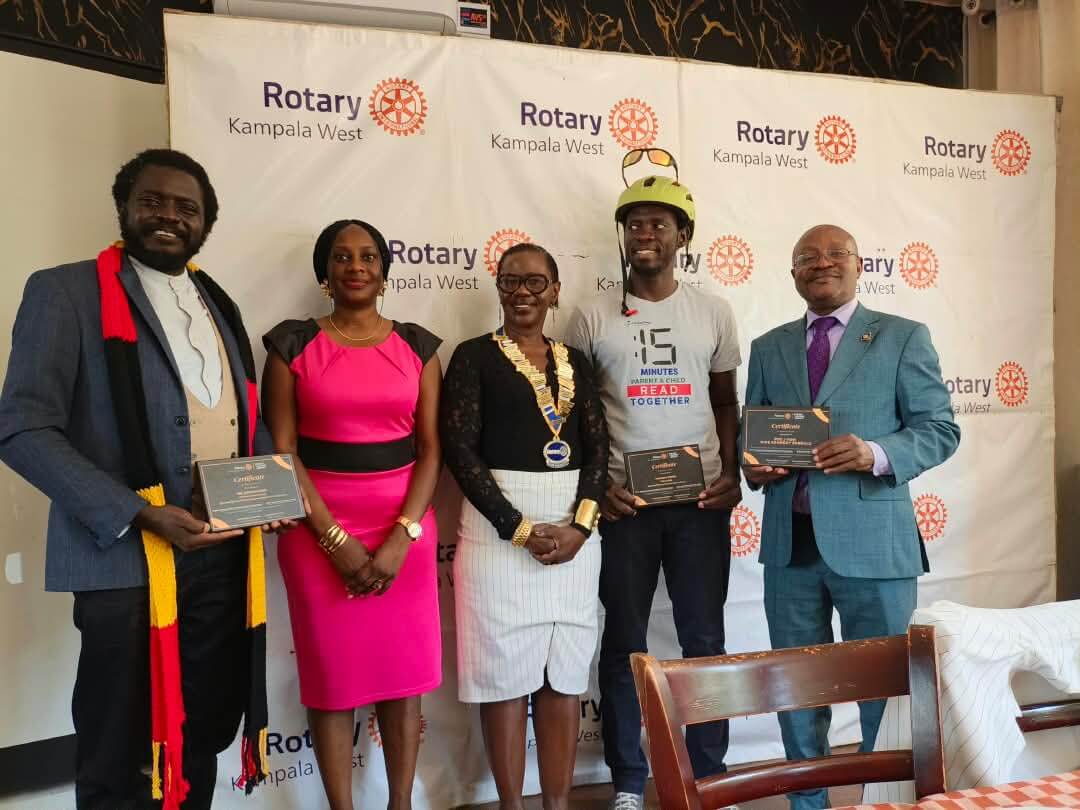
The initiative receives support from several partners, including Mandulis Energy, the International School of Uganda, the Rotary Clubs of Kampala West and Kyadondo, and Rapid Advisory, which Hakim identifies as supporters of children’s book access.
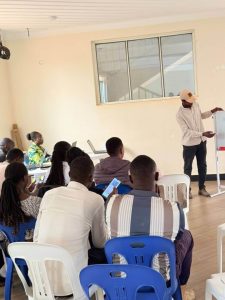
The Oxford College of Education also supports the initiative by providing continuing professional development opportunities for community literacy volunteers.
For Hakim, this combination of books, volunteers and parental participation is central to improving educational access.
“The sole focus is to ensure that the EduCycling for Early Literacy mission creates a book-rich environment for every Ugandan child, while empowering parents to mainstream 15 minutes of reading or storytelling with their children every day,” he says.
Beyond Books: Cycling, Screens and Wellbeing
Hakim also sees a connection between cycling, mental wellbeing and the need to spend more time away from digital screens.
In an age when phones and other devices compete constantly for attention, he believes physical activity can create space for reflection, social connection and healthier routines.
“Engaging in physical activity like cycling breaks one away from screen dependency, giving the mind a much-needed escape from the rectangular black screens in our pockets,” he says.
He sees a similar opportunity in daily parent-child reading.
For parents, putting away their phones and sharing a book or story with their children can create valuable moments of attention and connection.
The practice can also help children develop language, curiosity and confidence in learning.
However, Hakim believes lasting progress requires more than the efforts of one cyclist or one organisation.
Community participation, partnerships and parental involvement are essential.
“Every parent needs to take part by becoming their child’s very first teacher, simply by reading a book with them for 15 minutes every single day.”
A Journey Towards a Reading Nation
Hakim’s 10,000-kilometre mission is ambitious, but its central message is simple.
A bicycle can carry an advocate from one community to another. Volunteers can help bring books closer to children. Parents can turn a few minutes each day into opportunities for learning and connection.
Through EduCycling for Early Literacy, Hakim hopes these individual efforts will grow into a wider culture of reading.
For him, the journey is not merely about the distance covered on two wheels.
It is about the children reached, the families engaged and the possibilities opened through books.
And perhaps the most important part of that journey begins not on a road, but at home, when a parent sits beside a child and opens a book.